
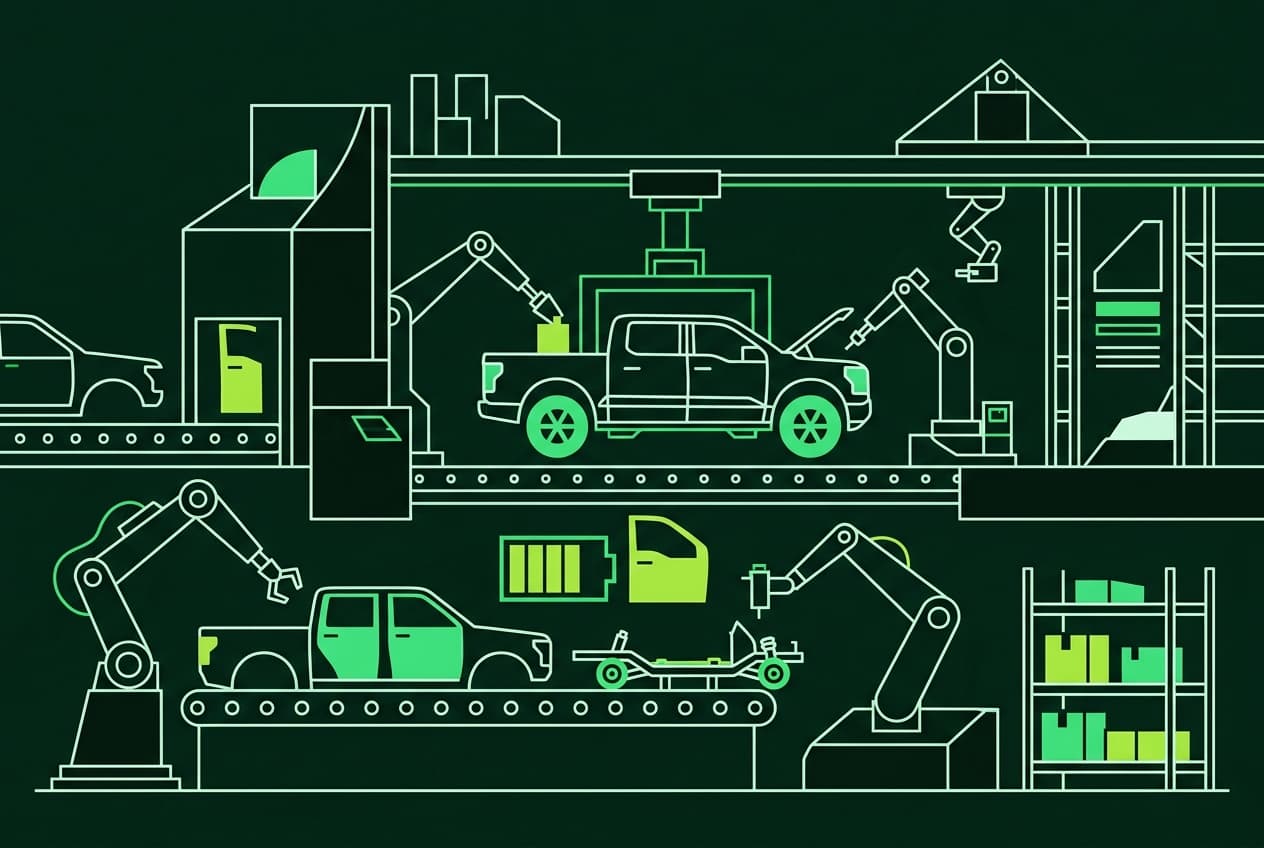
The Louisville Assembly Plant, a 3-million-square-foot facility, is undergoing a significant transformation from a gas-powered vehicle plant to one dedicated to building fully electric vehicles. This conversion, announced a year ago, involves a $5 billion investment that will create 4,000 new jobs and fund the necessary equipment for the UEV platform.
The UEV Production System represents a shift in manufacturing methods. Instead of a traditional assembly line, the vehicle is broken into three sections: the front clip, rear clip, and battery deck. Large unicastings will form the front and rear body sections, reducing the number of parts from 146 for the current Maverick to just two for the Fathom. Interior components are installed on the battery housing, which serves as the vehicle's floor, with the battery then attached from below.
This new system is projected to enable Ford to assemble the Fathom 40% faster than current vehicles at the plant. It is also designed to be more ergonomic, reducing physical strain for workers. The UEV Production System incorporates insourcing and automation to enhance quality and reduce costs, with the Louisville plant set to have the highest level of automation in final assembly across all Ford plants globally. This includes a software module flash station for instant updates and 5G connectivity for real-time quality checks.
The Ford Fathom will offer more interior passenger space than a Toyota RAV4. It will feature a large, high-resolution touchscreen, bidirectional charging capabilities (V2L), a digital key, and standard Apple CarPlay and Android Auto. The Fathom will also be the first vehicle to integrate Apple Maps directly into its navigation system, providing turn-by-turn directions and EV routing.